
How to Find Denver Residents
A Denver residents directory search works best as a short chain. A parcel result answers an ownership and assessment question. A voter record supplies a dated registration signal. A recorded deed names parties to an instrument. A directory or newspaper index can place a person at an older address. None of those records alone proves that every person connected with an address lives there today.
Choose the first source by the clue in hand. An address points to the Denver Property Record Search and the parcel map. A name can move through CountyFusion, court dockets, the public voter-file request route, and Colorado license or business databases. A historical question belongs with Denver Public Library, State Archives, maps, probate packets, or the General Index. If the online result stops at a record number, the custodian, a public counter, a phone call, a mail request, or a Colorado Open Records Act request is the next step.
- Save the exact name, address, parcel or year that started the search.
- Run the Denver property roll by address or parcel number, then record the schedule number, situs and mailing address.
- Use the relevant name or date search, such as CountyFusion, a Colorado docket search, or the state voter route.
- Compare the result with one independent signal, such as a reception number, license number, map, directory page or probate case.
- Ask the custodian for a copy or correction when the record image, eligibility rule or historical gap matters.
That sequence keeps a resident directory useful without turning unlike records into one claim about a person.
Denver Resident Records Offices
Denver is a consolidated city and county. That makes the Denver Clerk and Recorder, the Assessor, and Denver Elections central first stops for countywide questions. The Clerk and Recorder handles recording, marriage, public-trustee, election-administration and municipal-clerk functions. The Assessor presents parcel ownership, situs and mailing fields. Elections routes self-status questions to Go Vote Colorado and handles local requests. The Denver Clerk and Recorder office page gives the public office overview.
Denver Clerk and Recorder
200 W. 14th Ave.
Denver, CO 80204
311 or 720-913-1311
Denver Assessor
Webb Building front counter
Denver, CO
311 or 720-913-1311
The recording division lists 200 W. 14th Ave., 311, and 720-913-1311 as public contact points, while the local birth and death route and court clerks handle different records. A correct records route names the keeper before it names a result.
For a visual orientation to the recording, marriage, elections, public-trustee and city-clerk functions, the official Clerk and Recorder page is the relevant source.
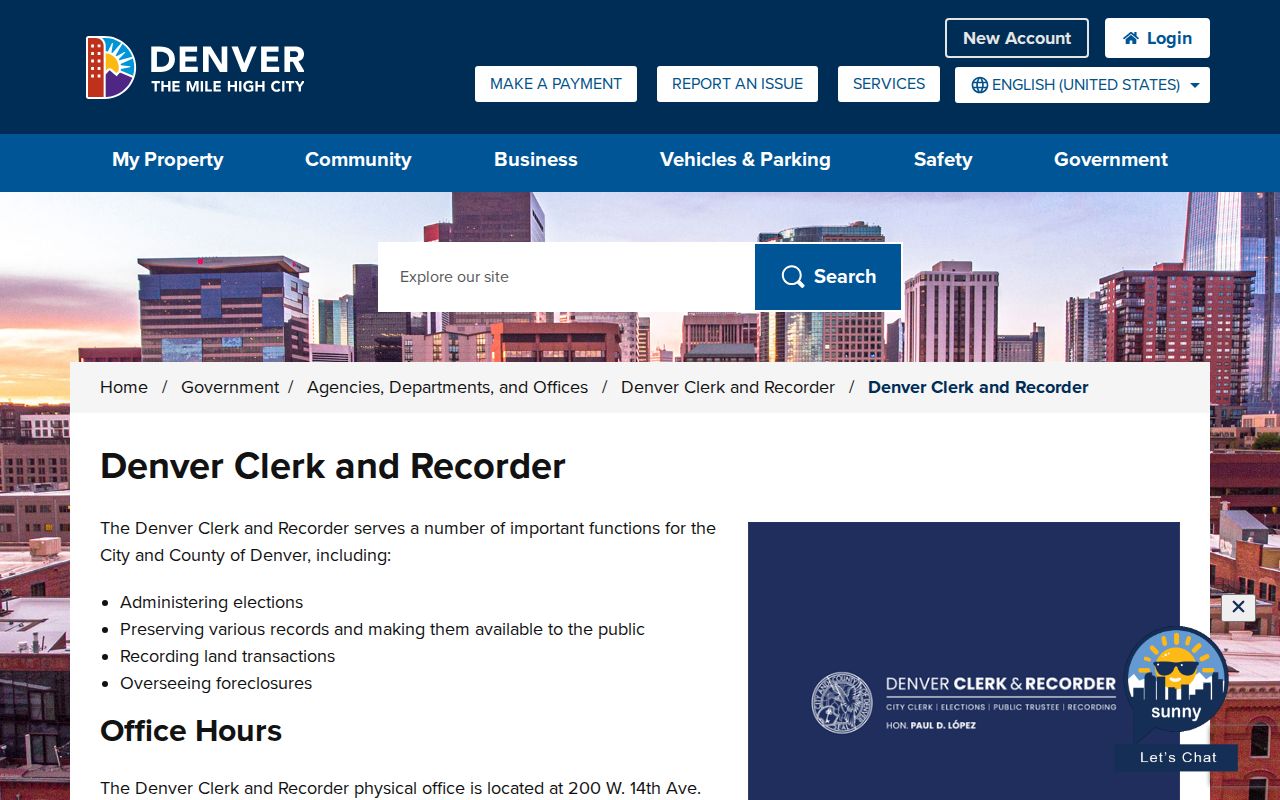
The office image anchors the local records map in Denver's consolidated city-county structure.
Start With Denver's Resident Property Roll
The Denver Property Record Search is an address-first public parcel tool. Its live configuration accepts Address or Parcel Number, with either input able to lead to a schedule-number result. The result card can show owner names, owner mailing address, situs address, legal description, neighborhood, tax district, style, bedrooms, baths, living area, year built, sale fields and assessed information. The portal was free and did not require a sign-in during the recorded inspection.
Situs means the physical location of the parcel. OwnerFullAddress is a mailing field for assessment or tax correspondence. They may point to different cities or states. That difference matters in a Denver property search because a mailing address is not proof of occupancy, and an owner card is not a household roster. Save the schedule number, legal description and capture date before moving to another source.
The Denver Property Record Search capture shows the address and parcel entry points used in this section.
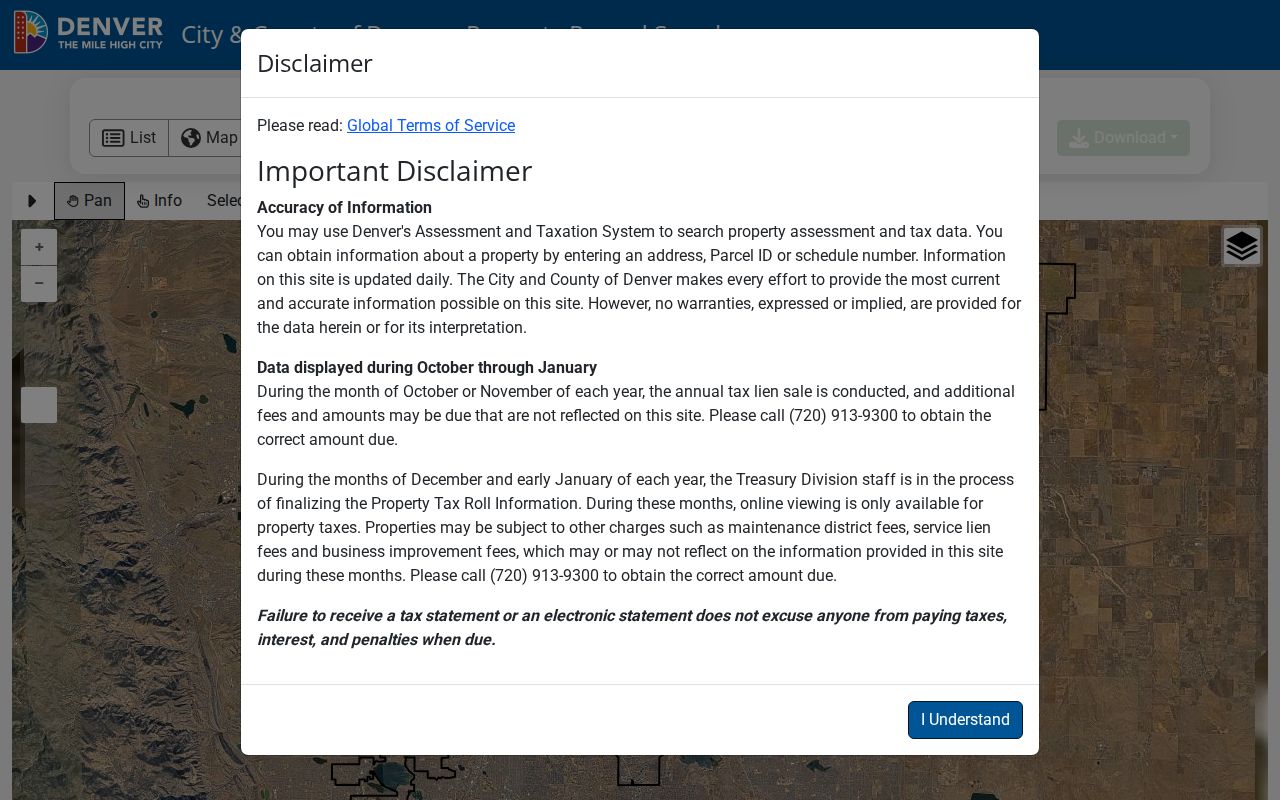
The property search capture shows the address and parcel entry points that start an official Denver lookup.
| Address | Text or autocomplete input; optional when a parcel number is used. |
|---|---|
| Parcel Number | Text or autocomplete input; the result uses Schedule Number and exposes PARID. |
| Owner name | Not exposed as an initial live input; owner names appear in results, and the Clerk guide documents a CountyFusion owner-name path. |
| ZIP | No initial ZIP filter was exposed. ZIPBASE can appear in the result configuration. |
| Result fields | Schedule number, address, value, sale fields, neighborhood, tax district, style, rooms, year built and living area. |
| Download | The inspected configuration showed list and Excel limits of 600 and 500; confirm current settings before any export. |
Seasonal tax notices add a caution. The portal says information is updated daily, but October and November tax-lien calculations and December or early January roll finalization can affect what appears. The Treasury contact listed in the research is 720-913-9300.
Denver Resident Records Since 1859
The Clerk and Recorder's document database is the strongest name-to-instrument bridge in a Denver residents directory. The Auditor's 2021 records-management audit described an online database running from 1859 through the present and more than 11 million recorded documents at the time. CountyFusion combines cashiering, imaging, indexing, redaction and reporting. Documents recorded during the day are batch-uploaded overnight and normally become searchable the next day.
CountyFusion results are not a list of everyone at an address. A row names a party to a recorded instrument. Deeds, deeds of trust, releases, liens, plats, marriage or civil-union licenses, and public-trustee material answer different questions. The one-page guest-search instructions show the path: open the records search, choose Search Records as Guest, accept the disclaimer, enter a last name and first name without punctuation, and inspect the reception result.
The Denver recorder search instructions show the guest and certified-copy controls.
The capture makes the reception number the practical bridge between an indexed row, a missing image request and a certified copy.
A live name inspection returned a 71-row sample for ALTARIA, with reception number, party types, names, instrument type, recording date, verification and image indicators. One visible row used reception 2025030117 and a lien instrument recorded April 8, 2025. Treat that as a sample schema, not a promise that every row has an image. If the image is missing, the Clerk directs researchers to email recording@denvergov.org with the reception number.
The Denver records hub gathers the recorder index, certified-copy route, marriage links and other official record paths.
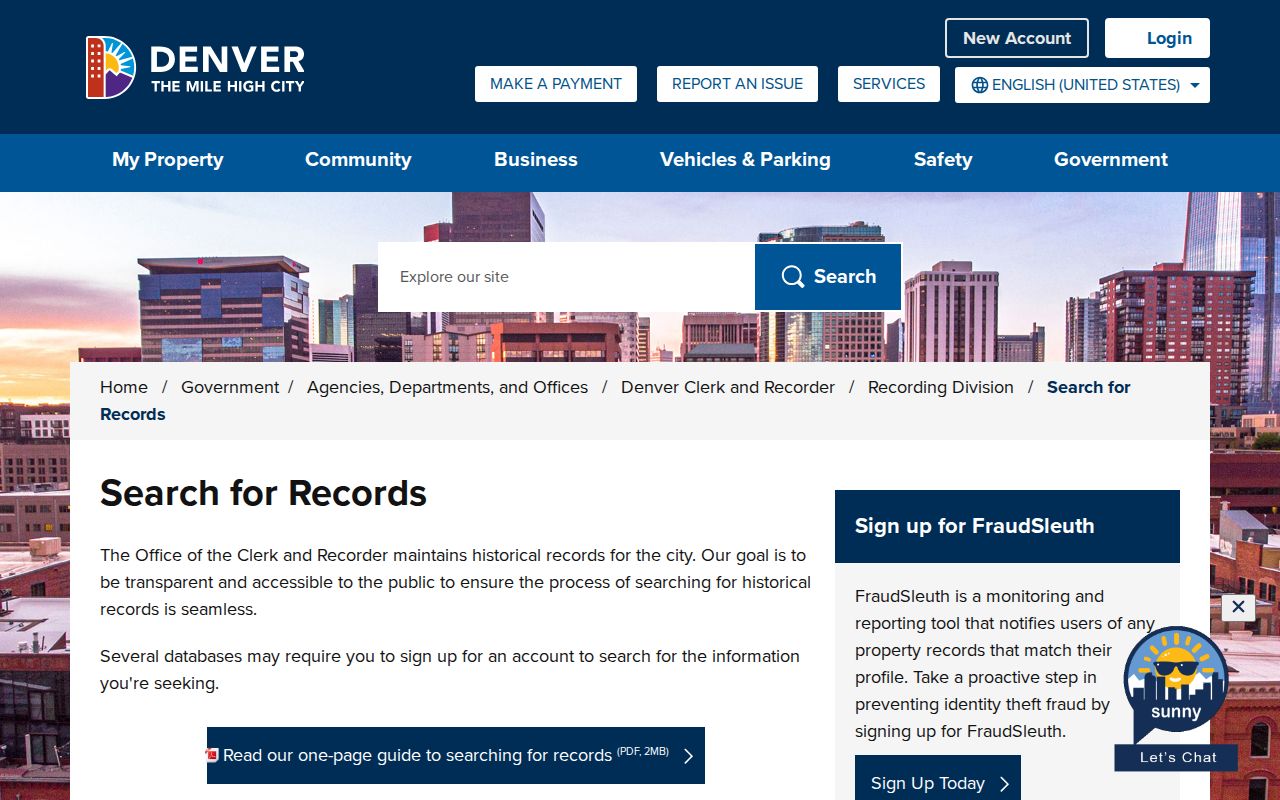
Use the hub when a name search leads to a different record keeper or when a document image needs a formal request.
Denver Resident Voter File Fields
Colorado's public voter data can add a dated registration signal to a resident-record workflow. The Secretary of State says public fields include full name, residential address, party affiliation and affiliation date, provided phone, provided gender identity, birth year and whether the person voted in prior elections. Confidential fields include Social Security number, driver's-license number, month and day of birth, signature and email.
The individual Go Vote Colorado route is for a person's own registration or ballot status. It is not a public block search. State extracts use a request form with the requester's name, contact details, report type, requested dates, signature, payment and delivery information. The current fee sheet lists $50 for an individual state voter report and $1,000 for a subscription. Denver Elections can be reached at 720-913-VOTE (8683), text 56003, or elections@denvergov.org.
A registration address is not occupancy proof. People move, keep an old registration until updating it, or use a confidentiality process. Always preserve the file date and the exact public fields, and do not seek the confidential fields.
Current Denver Resident Directories
Several public sources look directory-like, but each has a narrow purpose. The current Denver source set is made of source-specific views: a property card for parcel relationships, a voter extract for public registration fields, a recorder index for document parties, a permit portal for address records, and a neighborhood-organization layer for civic geography.
| Source | What It Lists | Keeper | Access |
|---|---|---|---|
| Denver Property Record Search | Owners, situs, mailing and parcel fields | Denver Assessor | Free address or parcel search |
| Public voter data | Name, registration address and listed civic fields | Colorado SOS / Denver Elections | Self-status or paid public extract |
| CountyFusion | Parties to deeds, liens, plats and other instruments | Denver Clerk and Recorder | Guest index; copy rules vary |
| Denver Accela | Record name, address, parcel and permit or case metadata | Denver CPD | Free search; attachments may vary |
| RNO GIS layer | Organization boundary, public contact and status | City and County of Denver | Free current civic layer |
These sources do not all describe residents. An organization feature is not a member list. A permit record is not a person card. A recorder party may be a trust, association, business or agency. For one-person verification, the Denver resident lookup workflow keeps those roles separate and adds court, probate, vital and license channels when they fit the question.
Official access is also layered. The property and recorder portals are online; assessor help is available through the Denver public-help route; court and vital records use their own clerks and eligibility rules; the library and archives cover older material; CORA is a fallback for existing releasable records.
Denver Resident Court Dockets Need a Date
Colorado Judicial Branch docket search is a date-driven finder, not a universal case-file download. The search requires a date plus another filter. Location fields include judicial district, county, courthouse and court type. Other groups cover division, case number, party or business name, and attorney name or bar number. A public row can show hearing date, time, duration, name, case number, hearing type, location, appearance type and courtroom.
Denver County Court has a separate quick portal. Its case panel accepts case number or arrest booking number. Its name panels return active future court dates, with last name, first name and date of birth for one panel, and last name, first name or business for a civil-date panel. A fuller file request goes to the court's data route. Electronic copies are usually free, paper copies are $0.25 per page, and certification adds $20 per document. Requests can be emailed to coradatarequests@denvercountycourt.org, mailed to 1437 Bannock, or made at the clerk counter.
A docket row confirms a public scheduled event in the portal's current coverage. It does not prove Denver residence, guilt, current custody or a final disposition. District, Probate, Juvenile and federal PACER records are separate channels.
Denver Resident Vital Records Are Eligibility-Gated
Colorado vital certificates are the clearest limit in a resident-record search. CDPHE says birth, death, adoption, marriage and divorce records are confidential under C.R.S. 25-2-117, are not public records, and are not searchable online. Release requires an eligible applicant with identification and proof of a direct and tangible interest or another listed relationship. The official sources inspected did not state a fixed automatic public-opening period.
CDPHE accepts online orders through approved VitalChek and GoCertificates links, mail applications, and appointment-only in-person service. The state office lists 4300 Cherry Creek Drive South, Denver, CO 80246, 303-692-2200 and vital.records@state.co.us. Denver's local birth and death office at 120 W. 5th Ave. uses its own application route and lists 720-295-7964. Denver marriage records follow the Clerk and Recorder, while divorce case files remain with district court clerks.
The Colorado Vital Records office page explains the confidential custodian structure.
The image reflects the state-level order route, while historical indexes at Denver Public Library and State Archives remain research leads rather than unrestricted certificates.
Historical Denver Resident Directories
Denver's historical residents directory shelf is unusually deep. Denver Public Library describes city directories from 1873-1923, householder directories from 1924-1937, and broader Polk and Criss-Cross holdings. A building-history guide describes microfilm from 1866-1981, digital city directories from 1873-1923, Polk and Householder or Criss-Cross material from 1924-2018, Colorado business directories, and Library of Congress telephone directories from 1912-1947.
The DPL General Index began in 1935, incorporates older Rocky Mountain News and Denver Times material, and closed new entries in 1995. Its approximately 6.5 million entries and one million cards can lead to obituaries, marriage notices, court items and civic events. A citation is a lead to a newspaper page, not a certificate. State Archives adds early reception books, elector registers, naturalization files and Denver or Auraria material from the pre-statehood period.
The full collection-by-collection treatment belongs on the Denver city directory page. A name, address and publication year are the key details to preserve before translating an old street form.
Denver Resident Privacy Programs Change Results
A no-result can be intentional. Colorado's Address Confidentiality Program gives eligible survivors a legal substitute address and confidential mail forwarding. Certification lasts four years with re-enrollment, and the program describes retroactive protection for 90 days. Denver also has a voter-record confidentiality form for defined protected groups and safety circumstances. That form applies to the voter record only, not every public record.
The Colorado Address Confidentiality Program is the correct starting point for a safety-sensitive address question. The form and the voter record distinguish current address, mailing address, phone, email, birthdate and identity proof. Public-record rules do not authorize publication of protected details, and a record that is public in one system may be closed in another.
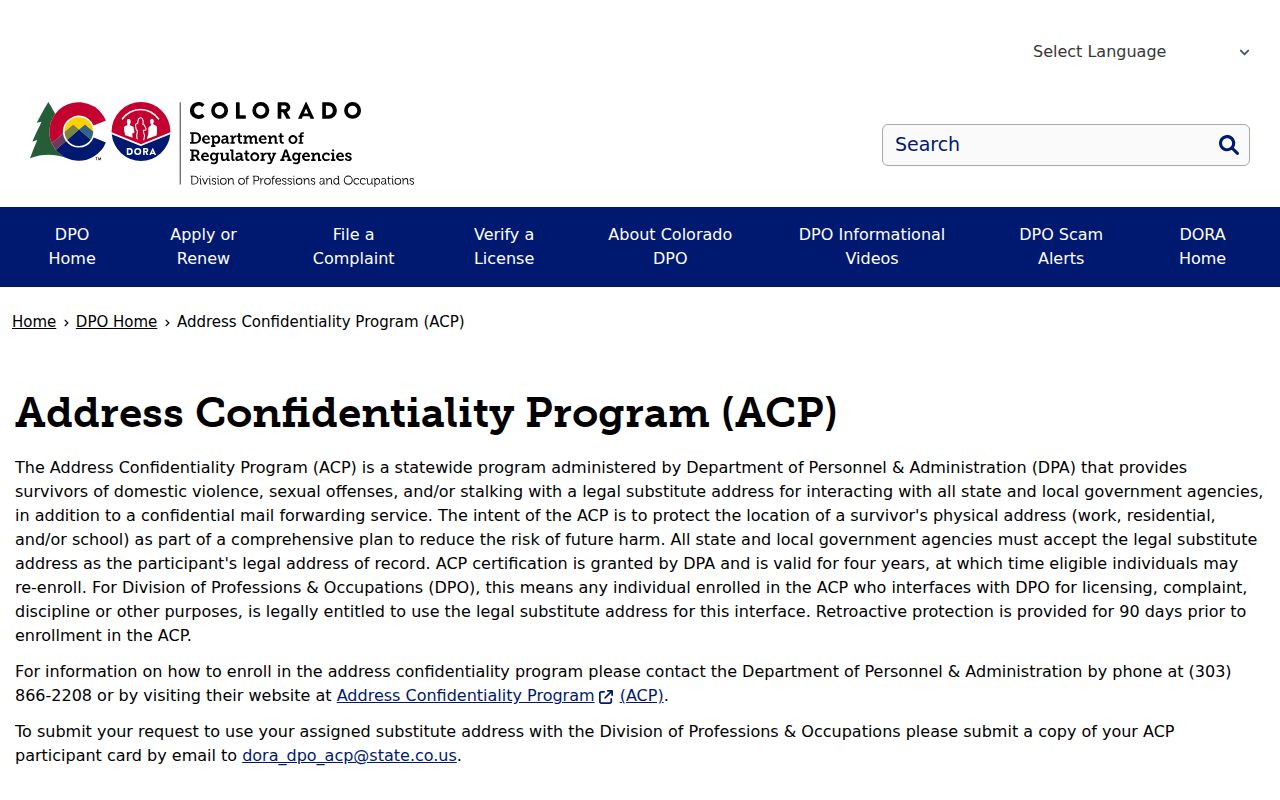
The ACP capture underscores why a substituted address should not be treated as a missing or false identity.
Lawful personal use. Public records support family history, civic research, reconnecting and personal safety awareness. Do not use a Denver records search to stalk, harass, intimidate or harm anyone.
When Denver Resident Searches Come Up Empty
Online does not mean complete. The Auditor says paper records that are not yet digitized may sit at five city-owned storage sites or with an off-site vendor, where staff can retrieve and digitize an item. A missing image therefore calls for the reception number and a request, not a guess that the deed does not exist.
For an existing releasable municipal record, the Denver Clerk and Recorder's CORA route accepts an online request. The office treats a request received after 3 p.m. or after closing as received the next working day. Colorado's Attorney General describes a three-working-day response rule, with up to seven additional working days for an extenuating circumstance. The first hour of research and retrieval is free, then the published maximum is $41.37 per hour, with copying at $0.25 per page.
The Colorado Open Records Act guidance is useful when the custodian needs a written request, an exception explanation or a segregable copy.
Use a record type, name, address, parcel or date range in the request, and ask for an existing record rather than a new custom report.
The Denver CORA request route shows the local version of that fallback, including the first-free-hour research rule.
The local request capture belongs beside the statewide timing rule because both affect when a Denver record search should be considered complete.
Denver Resident Rolls Versus Broad Search Tools
A commercial people-finder category may combine republished records, but it does not replace the named custodian. The better comparison is the field and date a source actually controls. County and state portals disclose their limits, while a broad result can merge similar names or stale addresses. The safest path is to use an official record for the fact and a second official or established historical source for context.
| Source type | Strongest signal | Important limit |
|---|---|---|
| Assessor parcel card | Owner, situs, mailing, legal description | Not a household or occupancy list |
| Recorder index | Recorded party, reception and document date | Image availability and party role vary |
| Public voter file | Dated registration address and public fields | Confidential entries and stale registrations exist |
| Library directory | Printed name and address at a past date | Gaps, spelling and publication limits apply |
Free access does not erase the need to read the source's scope. A public portal can be accurate for its field and still answer a different question than the one asked.
Denver Resident Portals Add Context
Colorado's statewide systems can confirm a public role or record category without becoming a Denver household directory. The Secretary of State business search covers business name, trademark, trade name, ID and document number. DORA license verification accepts profession, license type, number, name, business, city, state, ZIP and status. The Department of Corrections search uses DOC number, name, gender and CAPTCHA. The CBI registry states that it updates hourly but is not a complete list of every conviction. Federal BOP covers federal inmates from 1982 forward.
A business address is a filing address. A license city or ZIP is a license field. A custody or registry result has its own legal scope. Keep the identifier, date and source with every result. The Colorado sex-offender registry capture is a useful reminder that a public registry is not a general resident roster.
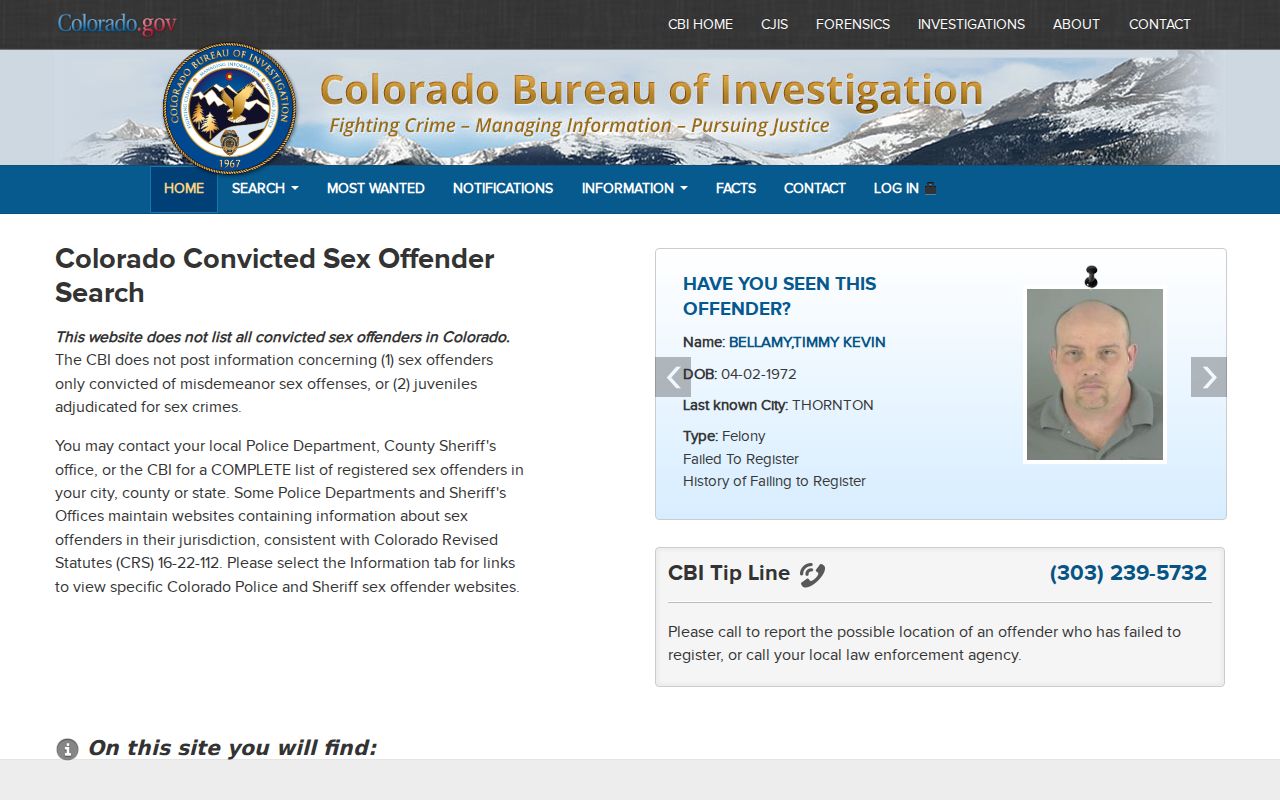
Registry warnings and exclusions should remain visible whenever a specialized statewide lookup is mentioned.
Read the Capture Date First
Every Denver records result has a time layer. The property portal displayed a live data timestamp of August 18, 2026. The SOS business page said paper documents were processed through August 17, 2026. The active RNO layer was edited in 2026, and election dashboards cover defined years rather than an endless live roll. Historical collections use publication years, filing dates, map years and archive series.
Write down the inspection date, query, result identifier, address type, record date and image status. When a page reports that a historical start was not located, preserve that uncertainty. A careful date trail is more useful than a directory that sounds complete but hides the boundary between current, indexed, digitized and request-only records.