
What a Denver Resident Lookup Can Confirm
Denver has no single official resident directory. A current parcel card, recorded instrument, voter file, docket, probate packet, directory entry, license result and permit record each confirm a different kind of connection. The right first search depends on whether the clue is a name, address, court date, family event, civic role or historical year.
| Record | What it confirms | Where | Access |
|---|---|---|---|
| Parcel card | Owner, situs, mailing and legal description | Denver Property Record Search | Free address or parcel search |
| Recorded instrument | Grantor, grantee, reception, date and document type | Denver CountyFusion | Guest index; certified copies paid |
| Voter record | Name, registration address, party/date, birth year and prior-vote indicator | Colorado SOS / Denver Elections | Public fields and request rules |
| Court docket | Party, case number, event date, court and courtroom | Colorado Docket Search / County Court | Date plus filter; fuller file by clerk request |
| Probate file | Decedent, heirs, representative, guardianship and dates | Denver Probate / FamilySearch history | Index and copy rules; pre-1988 gap |
| Vital record | Eligible certificate or verification | CDPHE or local custodian | Confidential; eligibility and ID required |
| License or filing | Profession, status, entity or registered filing address | Colorado DORA / SOS | Free search; not residence proof |
| Historical directory | Dated name-to-address or address-to-householder entry | Denver Public Library / LOC | Digital, microfilm or request route |
A lookup result becomes more useful when its source role stays attached. The assessor shows a parcel relationship. CountyFusion shows a recorded party. A court row shows a docket event. A directory entry shows a publication snapshot. A public voter field shows a registration record at a file date.
Start With Denver Resident Records
A name alone is a weak key in a large county. Normalize the full name, middle initial, former surname, spelling variants and any date or place clue. The CountyFusion guide says to enter last name then first name without punctuation. Colorado's Secretary of State business search suggests one or two keywords and no punctuation. DORA accepts any available field and supports a wildcard asterisk. Save the exact search syntax with the result.
An address-first search starts with the Denver property map, then uses SCHEDNUM, legal description and parcel geometry as stronger identifiers. A court-first search needs a date plus another filter. A family-history question can start with DPL directories, the General Index, marriage or divorce indexes, State Archives or probate. A license, business or permit record can confirm a public filing relationship, but its city, ZIP or mailing field must not be recast as a private residence.
Use in-person, phone, mail and email routes when a portal ends at an index. Denver County Court accepts records requests by email, mail and clerk counter. Denver District Court lists Room 256 and a records email. Denver Probate accepts in-person, phone, mail, email and an online request route. CDPHE uses approved vendors, mail and appointment-only service. DPL accepts focused research requests, and CORA can reach existing releasable municipal records.
Denver Resident Dockets: Date and Filter
The Colorado Judicial Branch Docket Search is a statewide date-driven docket finder. At least one filter besides the date is required. Location fields include Judicial District, County, Courthouse and Court Type. Other groups expose Division, case-number year/class/sequence, party or business name, and attorney name or bar number. A public result row can show date, time, duration, party name, case number, hearing type, location, appearance type and courtroom.
The Colorado docket-search capture shows the date, location, party and attorney filter groups.
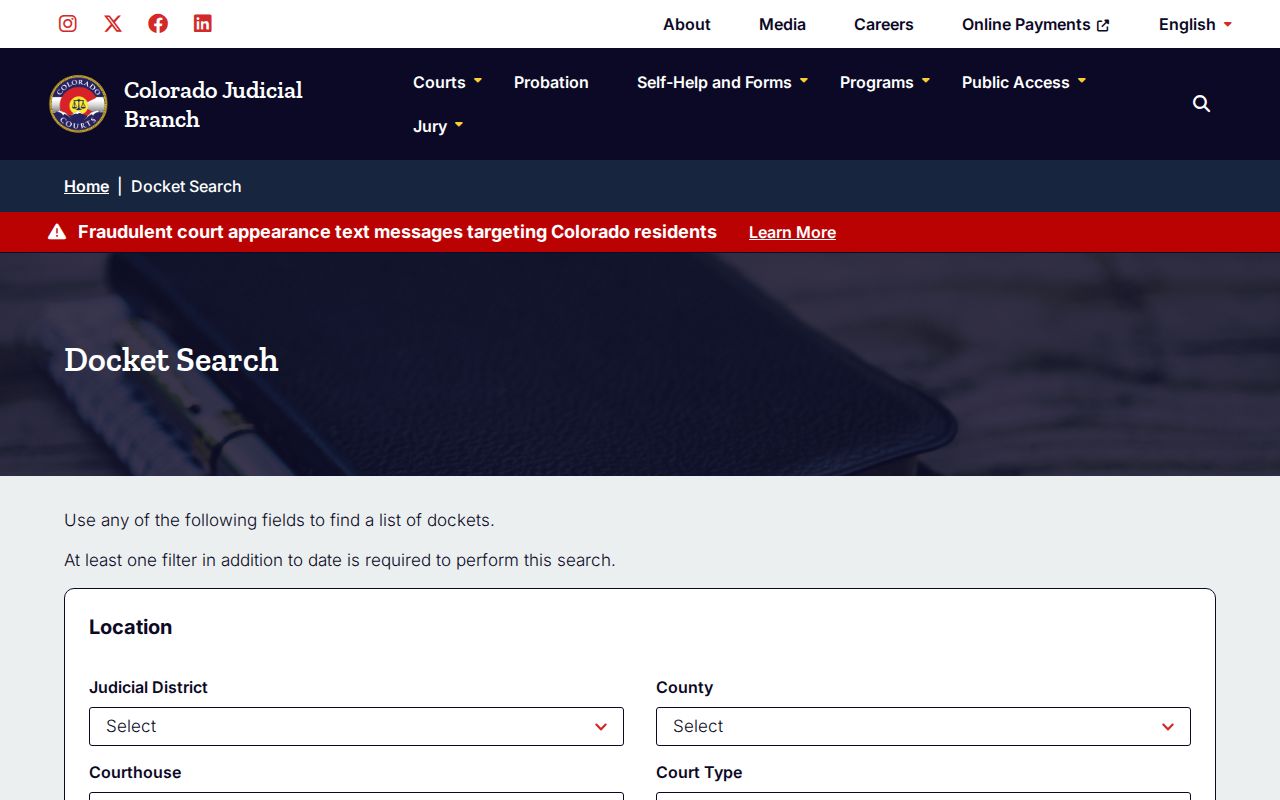
The statewide docket image clarifies why a date must accompany a name search.
The Denver County Court quick portal is narrower. One panel searches by case number or arrest booking number. A future court-date panel takes last name, first name and date of birth. A civil future-date panel takes last name, first name or business. These panels return active future dates and do not claim a complete historical case index. County Court records requests can be emailed to coradatarequests@denvercountycourt.org, mailed to 1437 Bannock, or made at the Lindsey-Flanigan or City and County Building clerk counter.
The Denver County Court quick-search capture shows the separate case and future-date panels.
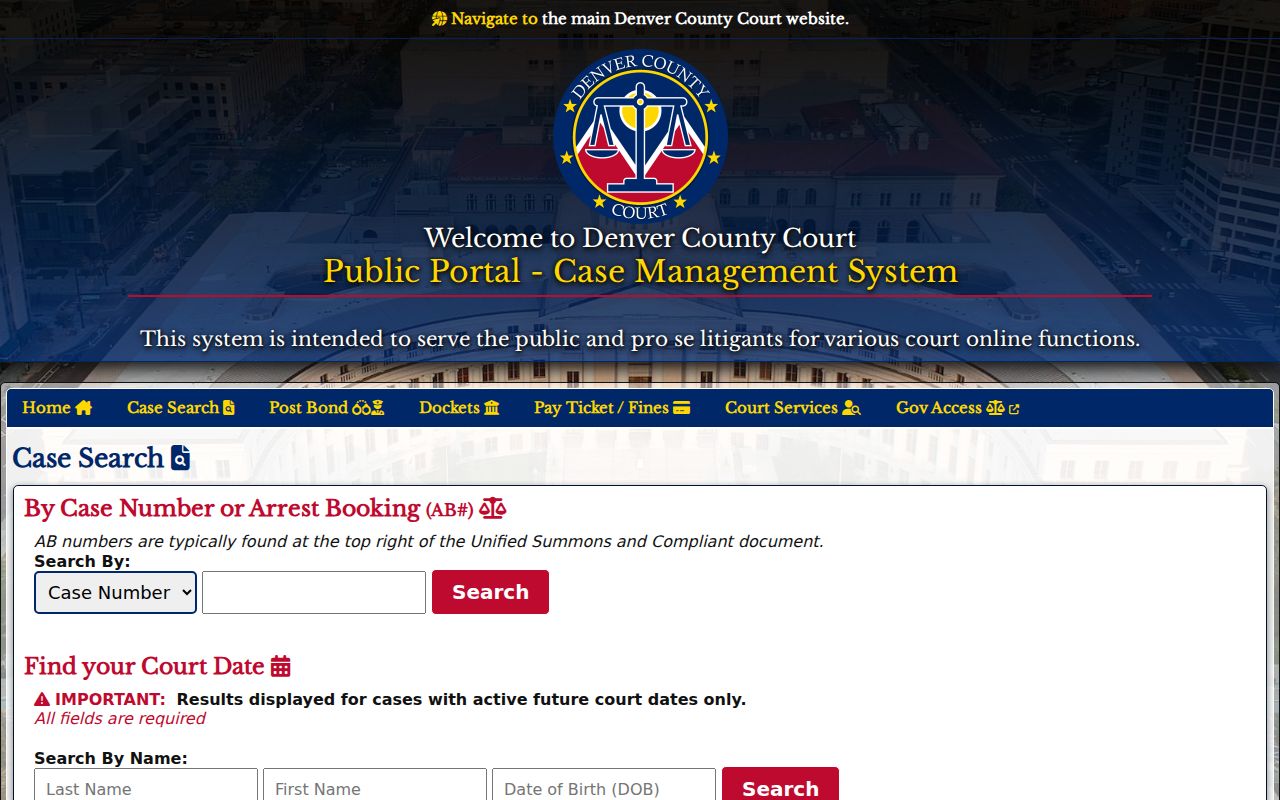
The image marks the boundary between an active court-date tool and a request for a fuller file.
| Location | Judicial District, County, Courthouse and Court Type select fields. |
|---|---|
| Date | Date Range or Specify a Date; a date is required. |
| Case number | Four-digit year, case class and sequence components. |
| Party | Individual or business, first name, last name or business name. |
| Attorney | Name or Colorado bar number, with first and last name options. |
| Result controls | Export Results and Printable Version; public rows paginate at 20 per page. |
A docket result is evidence of a scheduled or indexed court event. It does not establish current residence, guilt, custody or case disposition. District, Probate, Juvenile and federal PACER routes remain separate.
Denver Resident Probate: Heirs and Dates
Denver Probate is a useful one-person channel when the question involves an estate, heir, guardian, conservator or personal representative. The court page covers estates, wills, guardianships, conservatorships, account settlements, mental-health matters and extreme-risk protection orders. A filing may name a decedent, heirs, representative, witnesses, address and document dates, subject to sealed and protected-record rules.
The Probate clerk is at 1437 Bannock St., Room 230, with phone 303-606-2303 and 02DPCClerksOffice@judicial.state.co.us. Requests can be made in person, by phone, mail, email to DenverProbateRecordsRequest@judicial.state.co.us, or through the online portal. Provide case number, party name, date of death, date of birth, county of residence and documents sought. Without a case number, the court lists a $5 name search. Copies are $0.25 per page, certification is $20, exemplification is $20, off-site retrieval is $15 per case, and postage is $1 per ten pages.
The statewide probate index does not go before 1988. For older files, use the relevant county custodian, State Archives finding aids, or the historical FamilySearch collection. The Denver Probate records page is the access source.
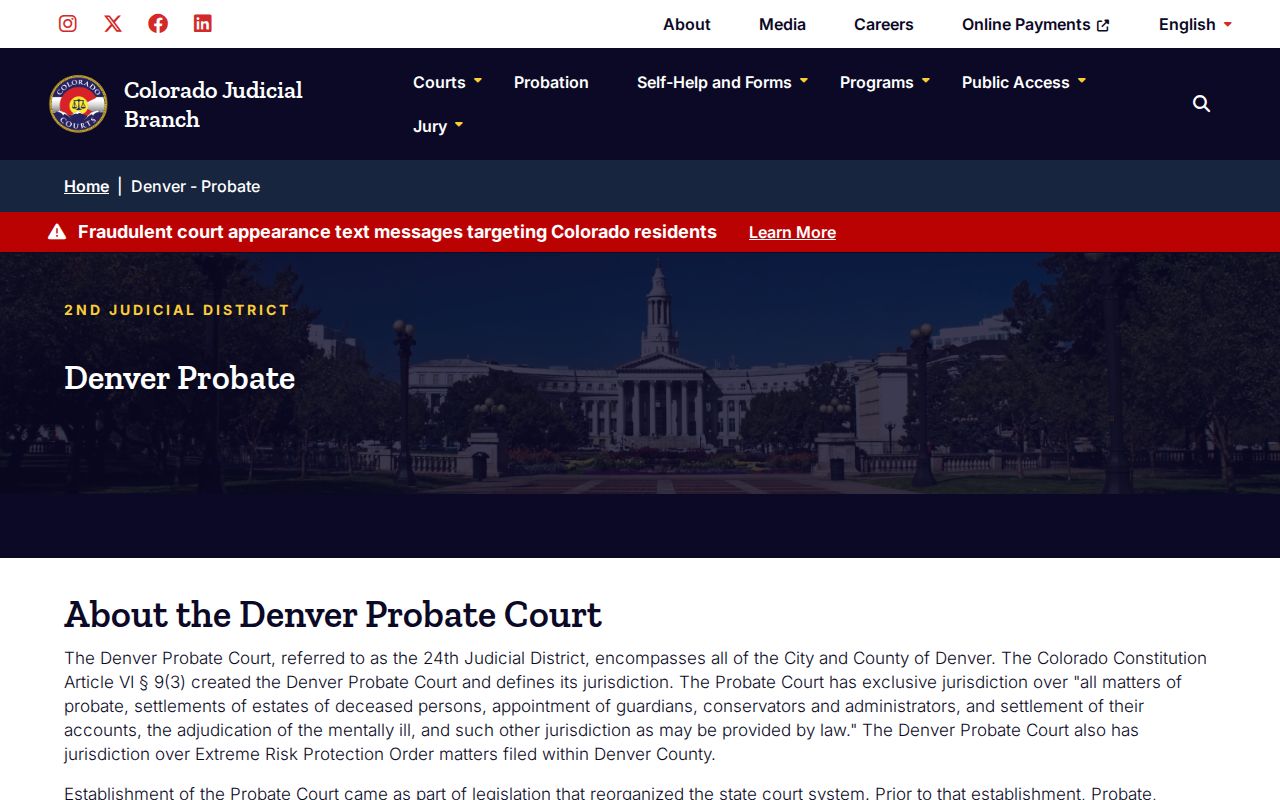
The probate capture highlights the name-search fee and the need to request the correct case material.
Denver Resident Voter Fields, Private Fields
Colorado makes a defined voter field set public. The SOS FAQ lists full name, residential address, party affiliation and date, provided phone, provided gender identity, birth year and whether the voter voted in prior elections. Social Security number, driver's-license number, month and day of birth, signature and email are confidential. A public voter extract is not a complete household list and the self-status portal is not a public bulk name search.
Go Vote Colorado routes an individual to registration and ballot status functions. Denver Elections lists 720-913-VOTE (8683), text 56003, TTY 720-913-8657, 200 W. 14th Ave., and elections@denvergov.org. State data requests use a form with requestor identity and contact fields, report type, dates, signature, copies, payment and delivery. The current fee schedule lists $50 for an individual report and $1,000 for a subscription.
The Colorado voter-status capture shows the public navigation rather than a block roster.
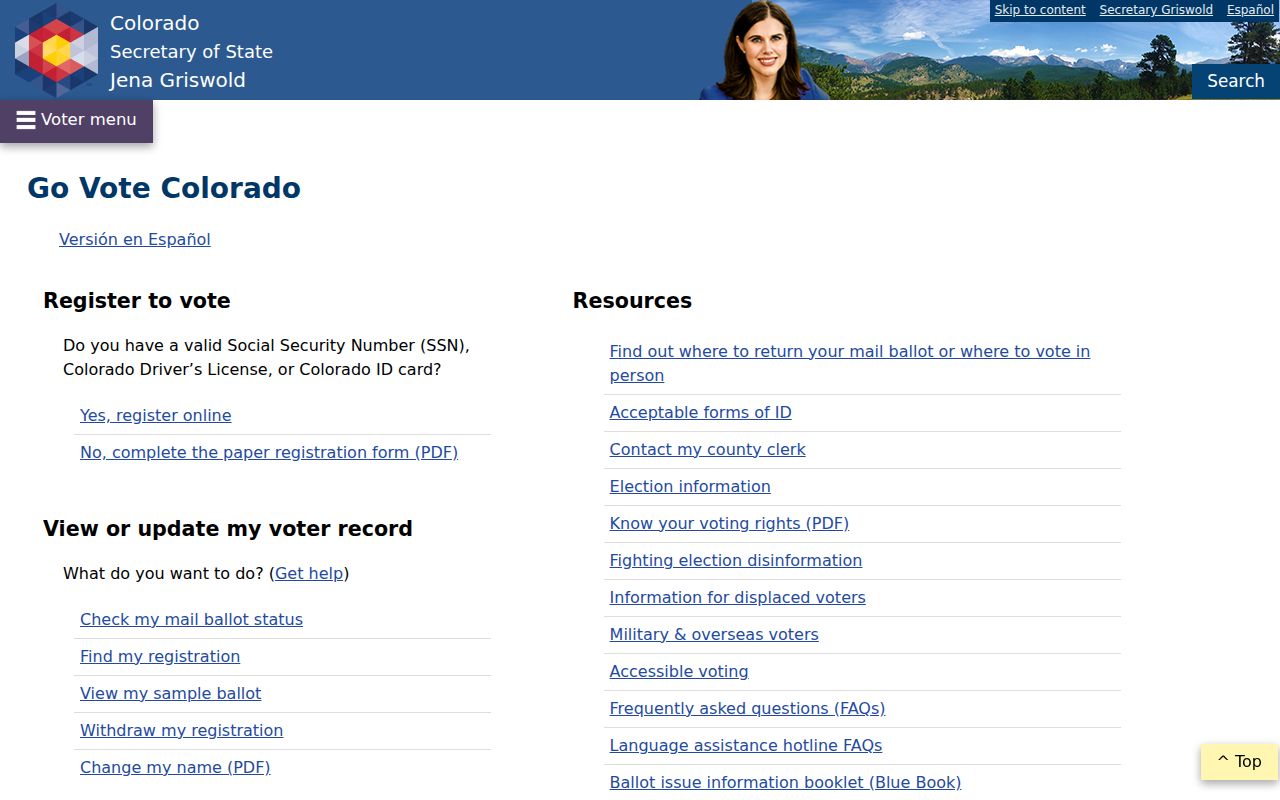
Use the file date and public field names when interpreting a voter result.
Denver's voter confidentiality form allows defined protected groups and safety circumstances to request protection. It asks for identity proof, current and mailing address, contact fields, birthdate, affirmation and category boxes. It says protection applies to the voter record only. The form did not show a current fee; an older local form and SOS FAQ described $5, so verify before requesting.
The Denver voter confidentiality form is the source for the protected-field workflow.
A protected voter result can be intentionally absent or substituted, so a no-result should not be treated as proof that no record exists.
Denver Resident Vital Records: Eligibility Limits
CDPHE says Colorado birth, death, adoption, marriage and divorce records are confidential under C.R.S. 25-2-117 and not searchable online. A certificate request needs an eligible applicant, identification and direct-and-tangible-interest or relationship proof. The sources inspected did not locate a fixed automatic public-opening period. Historical indexes and archive collections are separate leads.
Online orders use approved VitalChek and GoCertificates links. Mail requests require the completed application, identification copy, eligibility proof and non-refundable fee. In-person service is appointment-only. The state office lists 4300 Cherry Creek Drive South, Denver, CO 80246, 303-692-2200, vital.records@state.co.us and fax 1-800-423-1108. Denver's local Birth and Death Certificates office is at 120 W. 5th Ave. and lists 720-295-7964.
The Colorado vital-record order page shows the online, mail and appointment channels.
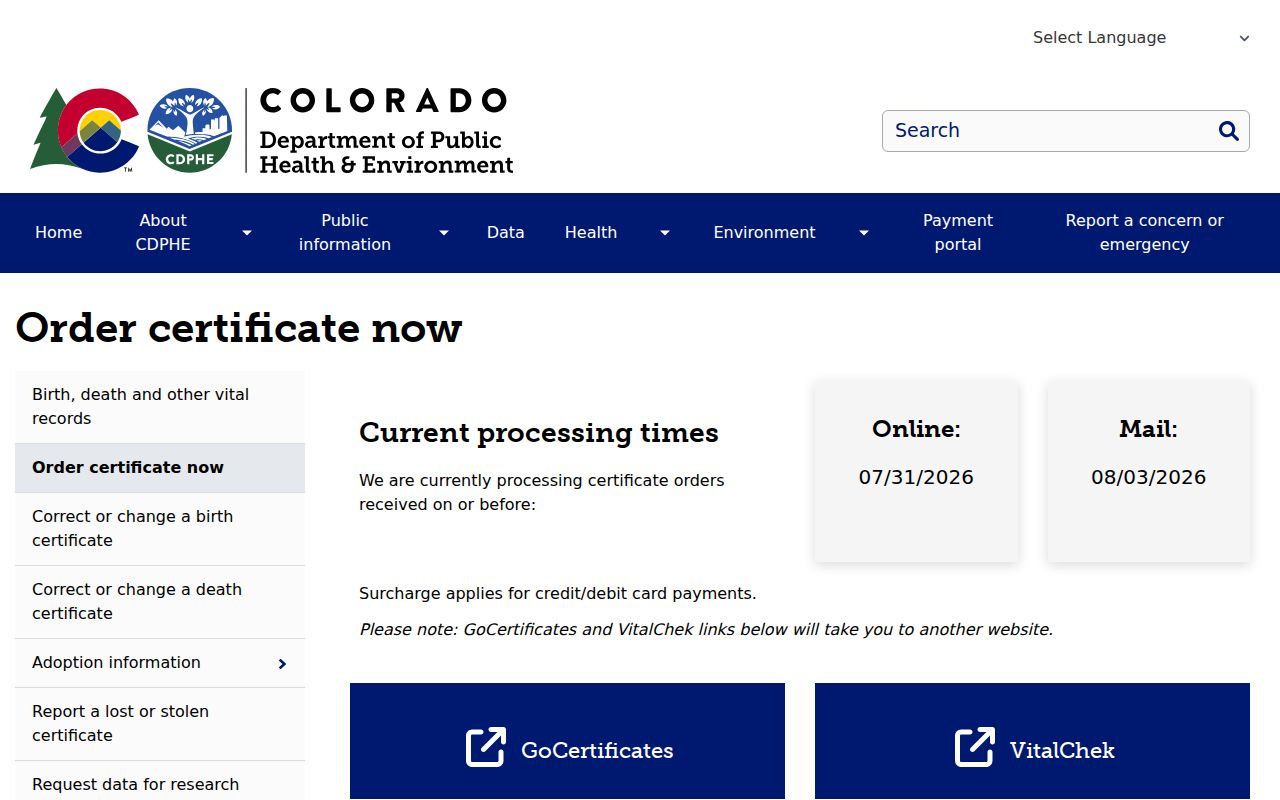
The order capture makes the eligibility gate visible before a requester treats an index lead like a certificate.
Build a Denver Resident Two-Signal Verification
A careful name search keeps a worksheet. Record the searched name or address, exact query, source URL, portal coverage date, result name, source identifier, address type, record date, status, image or copy availability, access restriction, second source and unresolved ambiguity. The identifier may be a schedule number, reception number, case number, license number or DOC number.
- Anchor the name to an address or parcel using the property roll, or keep the known address as the first signal.
- Run the court, voter, business, license or historical index that matches the question and preserve its date.
- Compare the name with a second independent identifier, such as a deed reception, case number, license number, map, directory page or probate packet.
- Request a certified copy or correction from the custodian when the distinction between index and image matters.
- Docket
- A court calendar or case-event record showing a scheduled or indexed proceeding.
- Index versus image
- An index describes a record; an image is the underlying scanned or paper document, which may require a fee or request.
- Certified copy
- A custodian-issued copy carrying formal certification, distinct from a screen view or research citation.
A useful match still keeps role and date visible. A parcel owner, a deed grantee, a voter registrant, a directory householder and a probate representative are not interchangeable labels.
| Property sample | ArcGIS OBJECTID 984741, SCHEDNUM 0003100118000, owner ALTARIA AT HIGH POINT COMMUNITY ASSOCIATION INC, Westminster mailing address, Denver situs, common-element class. |
|---|---|
| Court sample | Party name, case number, hearing date and time, hearing type, county location, appearance type and courtroom. |
| RNO sample | Organization boundary, public contact, status, website, member-count metadata and 2026 edit date. |
Denver Resident License and Filing Limits
DORA verification accepts profession, license type, prefix and number, last name, first name, business name, maiden name, city, state or province, ZIP and license status. A wildcard asterisk can broaden a search. The live source did not produce a populated sample, so the result columns should be checked before promising more than an official status or identity match.
Colorado SOS business search accepts business name, trademark, trade name, ID number or document number. Results can lead to entity name, ID, type, status, filing links, registered agent and address. Trade-name filings ask for true name, street and mailing address, trade name, description, effective date, attachments, email notices and filer affirmation, with a $20 fee. A business or trade-name address is a filing address. It is not residence proof.
Denver Accela searches record number, type, name, street parts, unit, parcel, city, state and ZIP. It can return permit or case attachments. These specialized sources add public context only when the field fits the question.
Legal Limits on a Denver Resident Lookup
Colorado's privacy and access rules shape a resident lookup. Vital and adoption records are eligibility-gated. Juvenile, sealed and expunged court material can be absent. DMV, utility, delivery and customer records are not public resident directories. The Address Confidentiality Program gives eligible survivors a substitute address. Denver voter confidentiality applies to the voter record and does not erase every other public source.
Colorado Open Records Act requests can seek existing releasable municipal records, but CORA does not override a specific confidentiality statute. Criminal-justice records use CCJRA. A custodian can require a case number, date, ID, relationship proof, payment or a narrower description. If a result is wrong, contact the office that owns the record and cite the identifier.
Lawful personal use. A Denver resident lookup is for family history, civic research, reconnection and other lawful personal purposes. Do not use a name or address result to stalk, harass, intimidate or harm anyone.
The safest fallback chain is official portal, public counter, direct phone, mail or email request, library or archive, then CORA when the record is eligible. A no-result can reflect a date limit, CAPTCHA, missing digitization, sealed file or confidentiality program.