
Denver City Directory Collections
Denver Public Library's Western History and Genealogy collections are the principal historical address-to-name layer for Denver County. Each volume is generally arranged by surname and may include occupation, address, a householder section, business or telephone details, and sometimes an ownership mark. The years are not one uninterrupted run, so use the collection name and exact volume year together.
| Collection | Years | Where held | Access |
|---|---|---|---|
| Early Denver volumes | 1866-1923 holdings; 1873-1923 digital run | Denver Public Library | Digital years and library access; gaps vary |
| 1887 name and street guides | 1887 | DPL digital PDF and local-history shelf | Name volume plus street/avenue guide |
| Householder directories | 1924-1937 | Denver Public Library | Address-first coverage is not uniform |
| Polk and Criss-Cross | 1924-2018 broader holdings | DPL microfilm or library access | Reverse address-to-householder method |
| Colorado business directories | 1875-1943, 1950, 1956 examples | DPL and partner collections | Business address is not a private residence |
| LOC telephone directories | 1912-1947 guide coverage | Library of Congress digital collection | White/yellow pages, exchange and number |
Some years are digitized, some are on microfilm, and some require a reading-room visit or a focused request. The directory page at Denver Public Library is the current collection doorway.
The Denver directory collections capture shows the year-by-year shelf and reverse-directory paths.
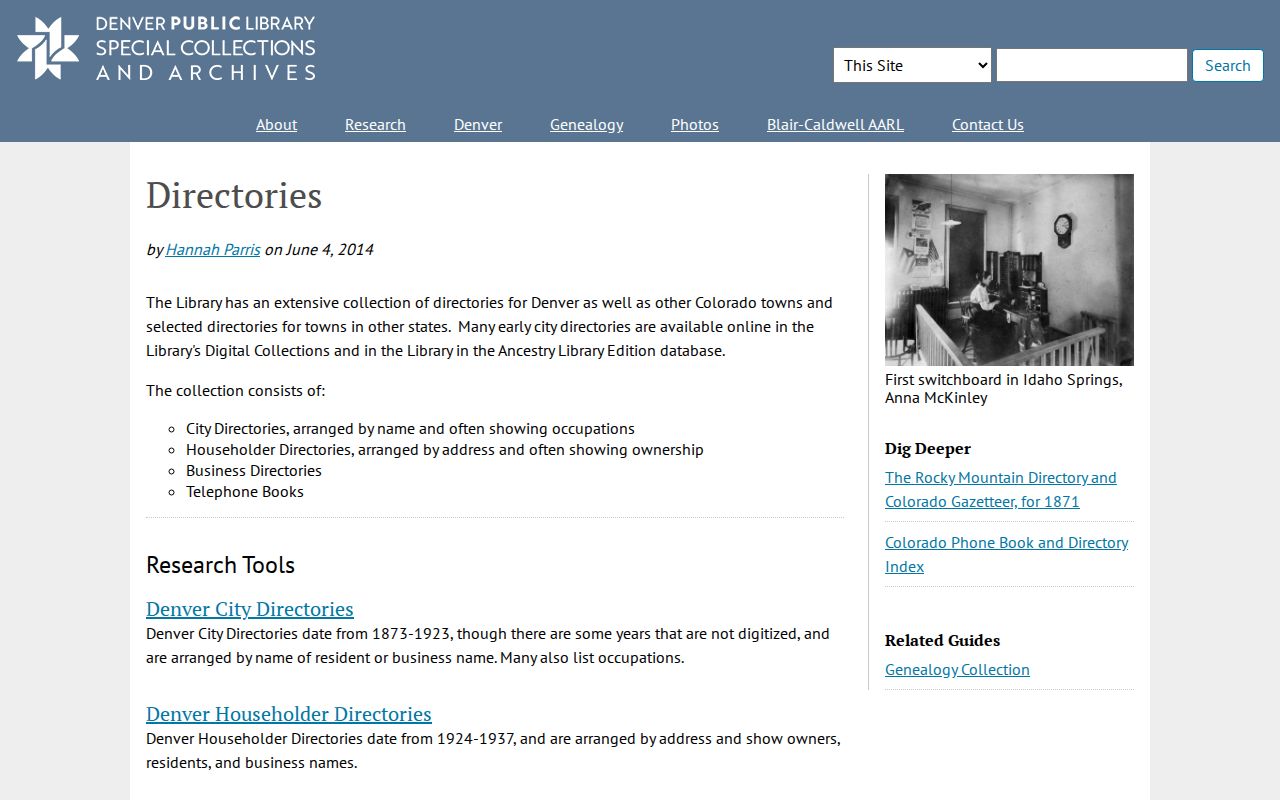
The collection image places the printed runs and access notes before a name search begins.
Denver's Local History Directory Shelf
The Denver Public Library building-history guide describes city-directory microfilm from 1866-1981, digital directory volumes from 1873-1923, Polk and Householder or Criss-Cross material from 1924-2018, Colorado business directories, and Library of Congress telephone directories. DPL's genealogy page also points to Ancestry Library Edition, American Ancestors Central, MyHeritage access, Fold3 Library Edition and PERSI citations. Those are library-supported research tools, not current official resident rolls.
A focused research request should name the person or address, likely year, resource type and citation clue. DPL's request route asks for requester name, ZIP, phone, email, subject and resource choices. Ordinary research requests generally take two to four weeks. The library cautions that it does not circulate materials, has limited copies and does not perform in-depth genealogy.
The DPL genealogy resource page shows how the historical shelf connects to partner databases and local collections.
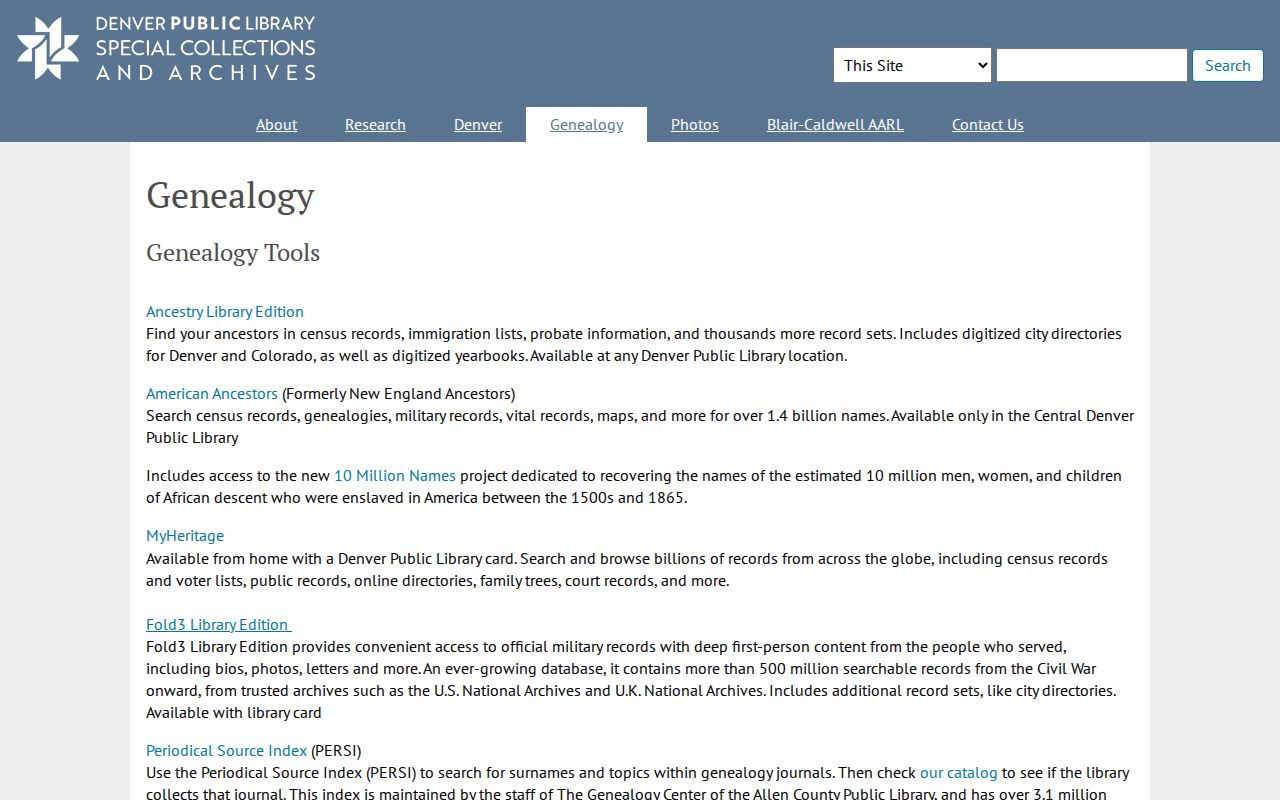
The genealogy capture places the directory volumes beside the library's other family-history channels.
Read Denver's 1887 Street Guide
The 1887 Denver directory is more than a name list. Its separate street and avenue guide explains a decimal numbering system centered on Broadway and Ellsworth, with 100 numbers per block and directional even and odd rules. A person listed in the name volume may not match a modern street string until that numbering system and the street-change record are checked.
The Library of Congress city-directory guide provides context for how name, address, occupation and telephone details appear in historical volumes.
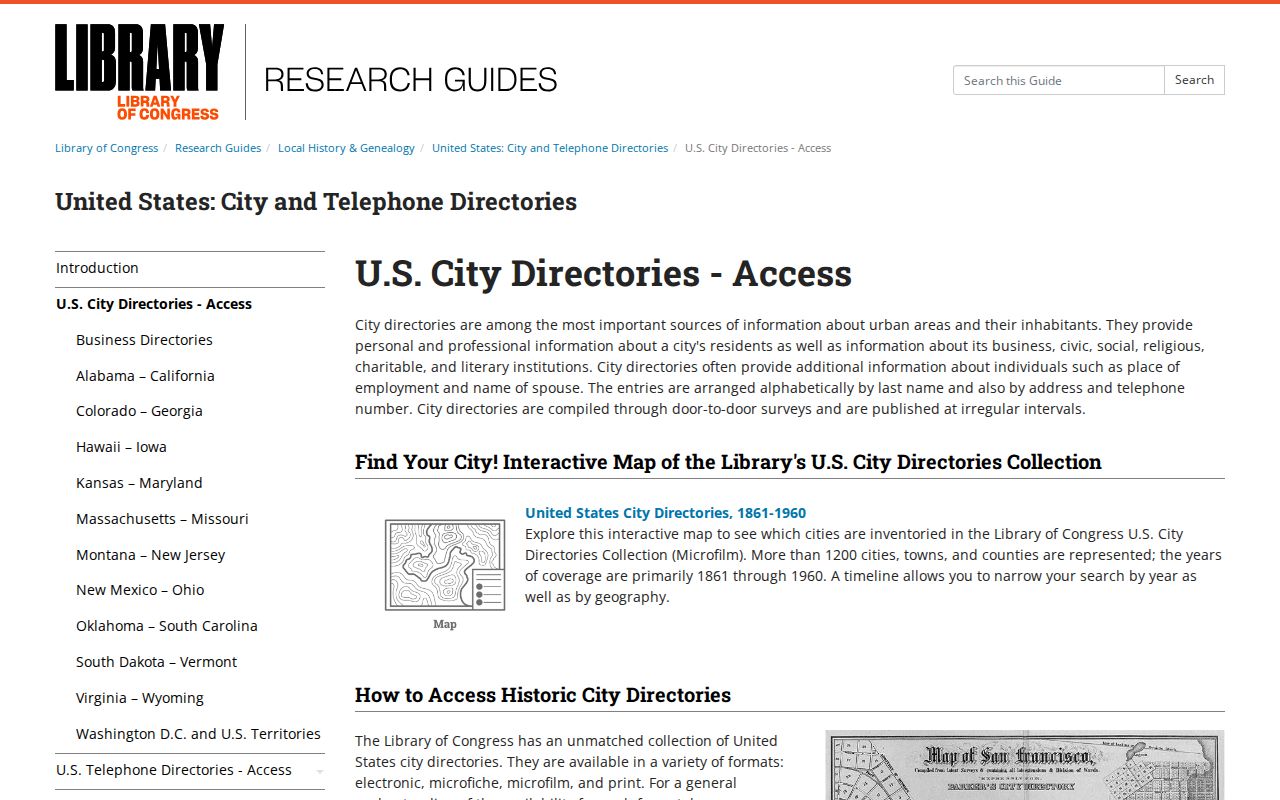
The guide image helps distinguish a historical volume from a current parcel search.
For an old Denver address, preserve the printed number, street name, cross street, block or lot, and volume page. DPL's street-change material identifies major downtown numbering work in 1887 and street-name changes in 1897 and 1904. Search old and new forms before concluding that a household disappeared.
Read a Denver Directory Entry
A directory entry is a publication record. It can place a person at an address for a year, show an occupation or business connection, and sometimes identify a spouse or householder. It does not certify a current address or prove title. The sample structure below combines the DPL 1887 name-and-street format with the Library of Congress telephone-directory fields documented in the research.
| Printed name | Surname and given name, with a spelling that should be copied before normalizing. |
|---|---|
| Address | House number and street, or an address-guide entry for reverse lookup. |
| Occupation | Work or business line when the volume includes it; do not turn it into a current fact. |
| Residence mark | Telephone volumes may use a residence marker, exchange and number; abbreviations vary. |
| Spouse or owner mark | Some runs include spouse, householder or ownership clues; record only what the volume prints. |
| Page and image | Volume year, page, scan or reel is the citation that lets another researcher retrace the entry. |
- Criss-cross directory
- A reverse volume arranged around an address or householder, useful when the street is known before the name.
- Householder index
- An address-oriented listing of the person identified as the householder for that publication year.
- Abbreviation key
- The volume's guide to marks such as residence, boarder or business notation; photograph or read it first.
A sample Library of Congress telephone entry exposes surname, given name, residence marker, street, exchange and number, with white-page and yellow-page divisions. A DPL 1887 entry pairs a name volume with a street and avenue guide.
Denver's General Index and Newspapers
The DPL General Index began in 1935, incorporates Rocky Mountain News material from 1865-1885 and Denver Times material from 1872-1913, and closed new entries in 1995. The page describes approximately 6.5 million entries and about one million cards. Search results can lead to obituaries, marriage announcements, court items, civic events and ordinary notices.
The important boundary is index versus source page. A card or digital result is a citation lead, not a death certificate, marriage certificate or court disposition. Preserve the newspaper title, page, publication date and any citation text. If the result is hard to retrieve, DPL's research request can use the deceased name, newspaper or citation, page, publication date, birth and death clues.
The Denver General Index is particularly useful when a name is absent from a modern search but present in an older newspaper run.
Denver Marriage and Divorce Indexes
Marriage and divorce material adds dates and relationships to a historical trail. DPL's Colorado guide describes an online marriage-license index covering 1902-1986, Denver marriage applications from 1903-2003, and Clerk and Recorder marriage certificates and licenses from April 21, 1903 to current. State Archives holds certificates from 1861-1952, license application stub books from 1874-1902, and Clerk and Recorder filings from 1860-1899. Denver certificates from 1861-1868 are scanned online.
Divorce is a district-court record. DPL describes a Colorado divorce research index for 1861-1941 and an Ancestry Colorado Divorce Index for 1851-1985. Those are research leads. A certificate verification or court file requires the correct custodian, eligibility and copy route.
The DPL marriage and divorce guide shows the index and historical-custodian split.
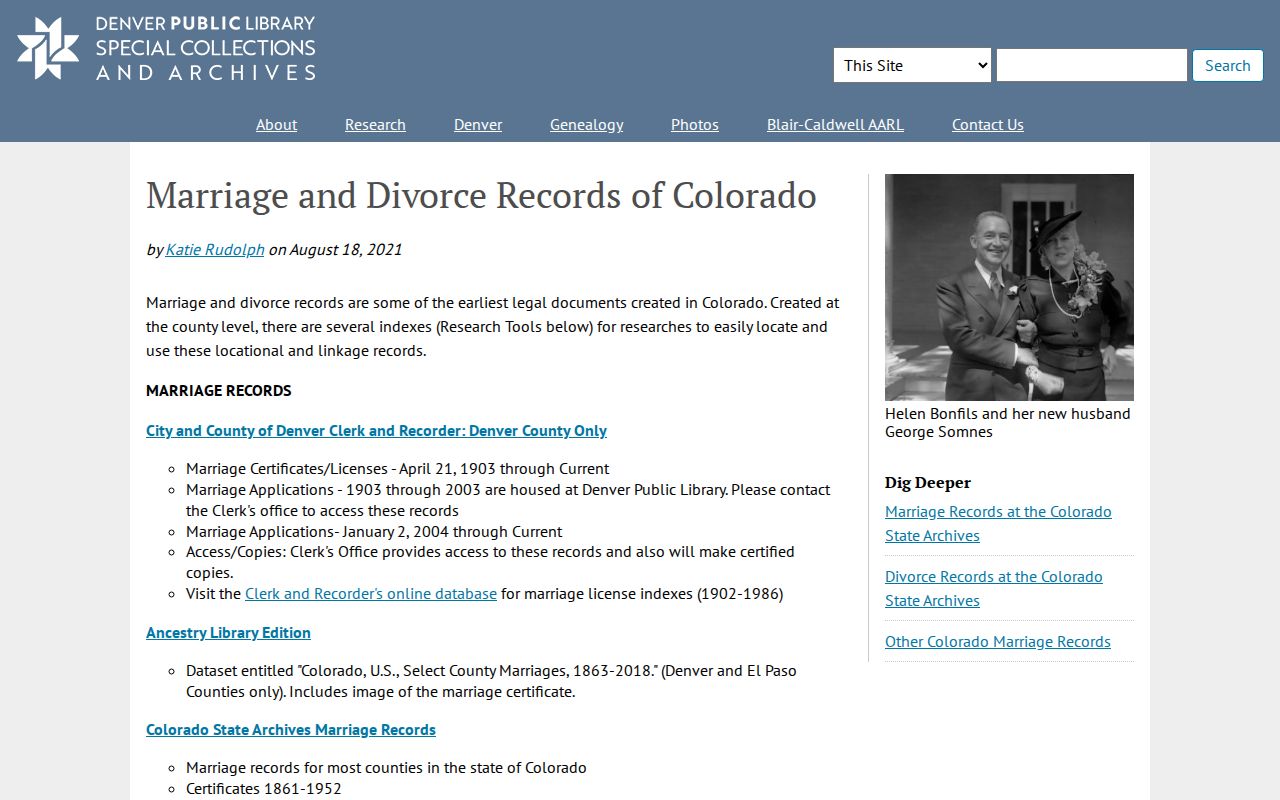
The index capture belongs beside a historical volume because it supplies a date or relationship clue without replacing the official record.
Denver Maps Explain Directory Addresses
Maps keep a printed entry tied to a physical place. Denver Public Library's building-history guide identifies Sanborn maps for 1887, 1890-93, 1903-04 through 1925, 1929-30 through 1961, 1962 and incomplete 1974 coverage. It also names plat maps, Robinson 1887, Baist 1905 and a 1940 Real Property Survey. The Library of Congress describes Denver Sanborn coverage roughly from 1887-1951.
Use a map to compare footprint, lot line, building use, street label and neighboring cross street. A map may resolve a renumbered address or subdivided lot, but it is not a current person index. History Colorado's Stephen H. Hart Research Center adds archives, photographs, maps, manuscripts, newspapers and artifacts, with reading-room and reproduction rules set by the collection.
The History Colorado Hart Research Center is the established historical-archive fallback.

The research-center capture shows where directory, map and manuscript questions can move when a library scan ends.
Denver Directory Eras in Order
The printed shelf changes shape over time. A simple timeline prevents a researcher from treating a missing year as proof that a person or address vanished.
- 1866-1923: early Denver city-directory holdings, with a digital run identified for 1873-1923.
- 1887: separate name and street or avenue guides explain decimal numbering.
- 1924-1937: householder directories add an address-first view.
- 1924-2018: Polk and Criss-Cross holdings extend reverse directory work across later years.
- 1912-1947: Library of Congress and DPL telephone-directory material supplies historical phone and address snapshots.
Publisher, format and access change across those eras. A microfilm year may need the library reader, a digital year may have page controls, and a licensed database may require a DPL card or on-site access.
Trace Denver Households Through Directory Years
Family-history work is strongest when a directory is paired with another dated source. Start with the exact printed name and address, then move through the collection eras without smoothing over gaps. If a name disappears, the reason may be a move, death, spelling change, a missing volume or a shift in who the publisher indexed.
- Choose a likely year and search the name volume, saving the printed name, address, page and occupation or residence mark.
- Turn to the address or householder section for the same year and inspect nearby entries.
- Repeat in the next available directory era, translating street numbers and names through DPL's change material.
- Pair the snapshots with a recorder reception, assessor history, Sanborn map, probate packet or newspaper citation.
- Use the official custodian for a certified copy when a historical index points to a vital or court record.
When a current address becomes the goal, the Denver resident lookup page adds modern court, voter, vital and license boundaries. The historical volume remains the publication layer.